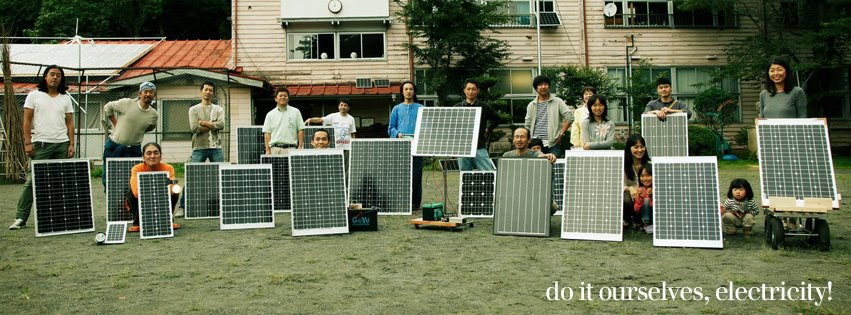
Let’s start this month in Japan, and this wonderful article that appeared on Our World 2.0 called Transition Town Fujino goes for local energy independence. It included the gem that “as of July 2012, one transition town starts up every week”, and also this beautiful paragraph:
“Transition Towns in Japan identify themselves with the initials “TT”, which also stand for the Japanese words tanoshiku and tsunagaru, meaning “having fun” and “networking”. True to these words, people involved in Transition Fujino work towards transition while making it a point to enjoy life and avoid overworking. A resilient, secure and happy way of life is reinforced by the warm connections between local people that are nurtured by the Transition Town movement”.
I was out for a bike ride with my 10 year old last weekend, and on the cycle path, a large oak tree had come down in a recent storm, blocking the whole path. The middle section had been removed so the path could be used, but the rest of the tree was still in place on both sides of the path. On one side, the big cut trunk was at head height, and was an arresting site as you cycled past it. What was particularly arresting was that it had become the inspiration for some delightful creativity, a real celebration of the life of this huge and beautiful tree.
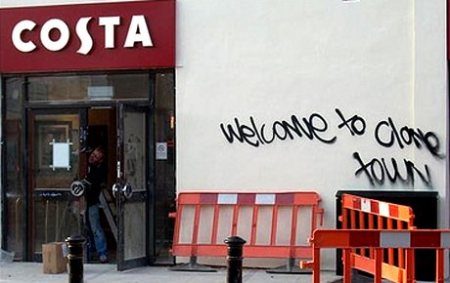
Yesterday was a day that produced the most extraordinary news. For the last 8 months or so, the No To Costa campaign in Totnes, supported by Transition Town Totnes, among others, has been campaigning to stop Costa Coffee from opening a branch in Totnes. Communities always lose battles like that don’t they? That’s certainly the experience in most places. But yesterday, Costa Coffee, a huge company with nearly 1,400 outlets, announced that “we had an open and constructive discussion and as a result … we have carefully considered the points made and decided not to open on Totnes high street”. Its MD Chris Rogers, much to his credit, said “Costa has recognised the strength of feeling in Totnes against national brands and taken into account the specific circumstances of Totnes”. Extraordinary. Here it is on yesterday’s ITV News.
I have written several times here about ‘Transition Streets’, the street-by-street behaviour change model created by Transition Town Totnes which was the winner of the 2011 Ashden Award for behaviour change. There is a good evidence base now, showing how it enables a Transition (or other) group to reach the parts that other community engagement projects may not, becoming ‘green by accident’ by having a good time. It is an approach to change which is self-propelling with tea. It embodies the Transition commitment to self-organisation, the groups managing themselves and determining themselves once the project has been set running. Here is a short video about it:
What I am delighted to announce today is that now Transition Streets (also known as ‘Streets-Wise’) is available for any group to run, anywhere.
In the context of the fascinating week of posts looking discussing Transition Network over at the Social Reporters’ blog, it was fascinating to read an important new study by Gill Seyfang, Jung Jin Park and Adrian Smith from University of East Anglia about community energy. ‘Community Energy in the UK’ is the first independent UK-wide survey of community energy projects (you can download it here). One of the most interesting things to emerge from the paper is the role Transition Network plays in the field, in spite of being a very small organisation, and it offers some insights into why that might be.
How might our response to peak oil and climate change look more like a party than a protest march? This site explores the emerging transition model in its many manifestations
Read more»