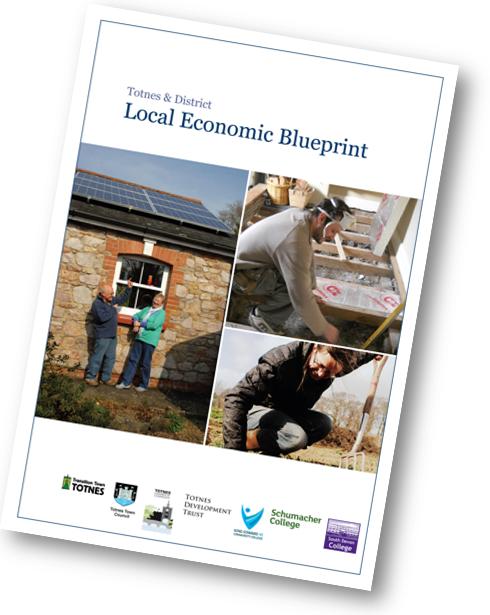
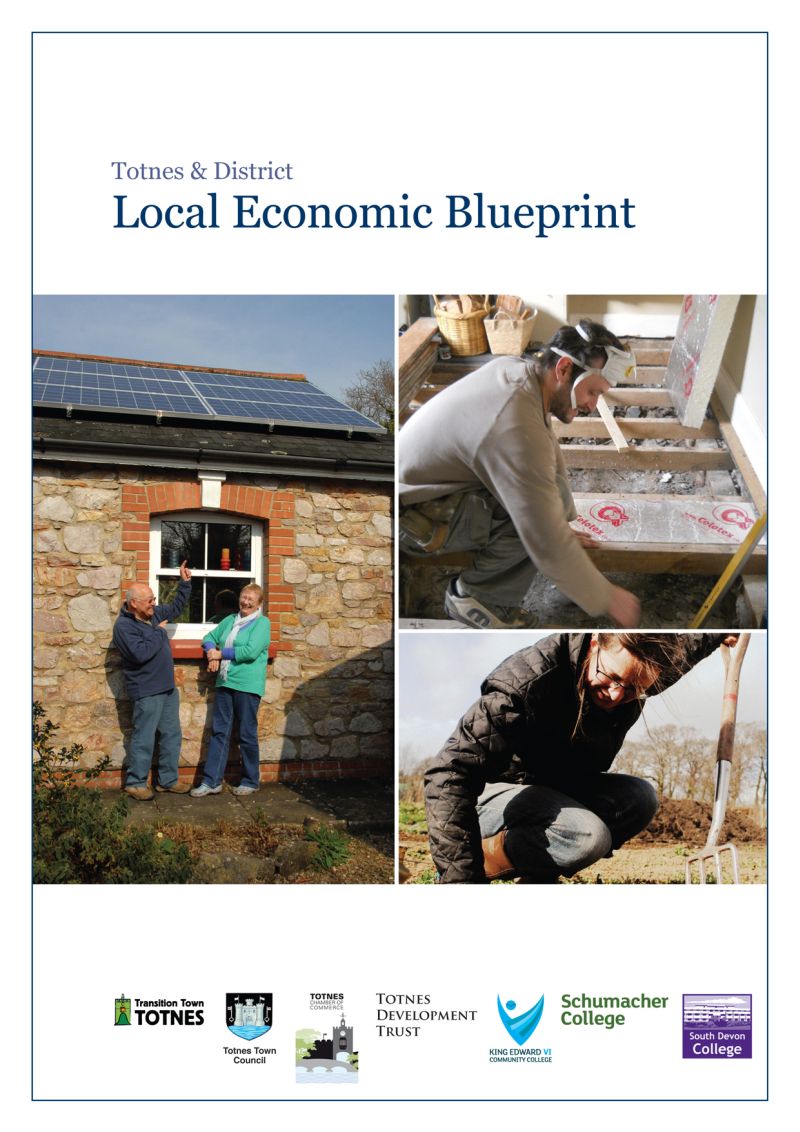
South Hams District Council took an active role in the creation of the Totnes & District Local Economic Blueprint, so I sat down with Richard Sheard, Chief Executive Officer at SHDC and began by asking him why he thought the Blueprint matters.
You can download the Blueprint here, and see the first review of it here. Have a good Easter.
Today sees the publication of what may well turn out to be one of the most important documents yet produced by a Transition initiative. Over the next few weeks we will be returning to it, to hear a range of perspectives on it, and hope it will generate debate and discussion. The document is the ‘Totnes & District Local Economic Blueprint‘, and you can download it for free here. The Blueprint is the first attempt that I am aware of to map in detail a local economy and to put a value on the potential benefits of an increased degree of localisation. If you like, it identifies “the size of the prize” of Transition.
Here Fiona Ward of the REconomy Project introduces the Blueprint:
Today’s post is really a warm-up for tomorrow’s. Tomorrow morning, Transition Network’s REconomy Project will be publishing the first of 3 ‘Local Economic Blueprints’, for Totnes and District (those of Hereford and Brixton are in the pipeline). I think it is one of the most important pieces of work that has yet to emerge from a Transition initiative, a real leap forward in terms of arguing the case for more local and more resilient economies. For now, to give you a taste, here is the foreword I wrote that didn’t get used in the end, but which captures why I think it matters:
“Something remarkable is happening in Totnes. Something that is starting to be noticed elsewhere, something that’s a vitally needed story in communities up and down the country. Greg Barker MP, former Minister for Communities and Local Government, noticed it recently when he told Parliament “what Totnes does today, the rest of the country will do tomorrow”. The Western Morning News noticed it when they ran a lead editorial called “Hippy town comes of age”. Chef and campaigner Hugh Fearnley-Whittingstall noticed it recently when he spoke of Totnes “blazing a trail for those who are interested in finding new heart in their community”.
Every now and then I do a round-up of books you might find interesting, the ones that are accumulating by my bedside. Haven’t done one for a while, so here are a few books that you might enjoy that I have found especially fascinating of recent. I have also given the links to where you can buy them direct from the publisher, should you so wish.
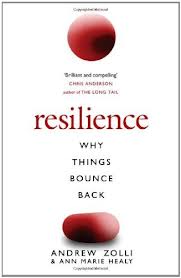
I’d go so far as to say that this is the best book I have ever read on resilience. After as good an explanation of the core idea as you’ll find anywhere, ‘Resilience’ goes on to look at what it looks like in relation to individuals, groups, communities, and society as a whole. I found it fascinating, packed with insight from a range of fields and disciplines, and inspiring in the clarity of why this stuff matters. I particularly liked the bit that said “no such system is ever perfect, indeed just the opposite: A seemingly perfect system is often the most fragile, wile a dynamic system, subject to occasional failure, can be the most robust. Resilience is, like life itself, messy, imperfect, and inefficient. But it survives”. If you only read one of these book suggestions, make it this one.
“a volunteer-led project which aims to help Londoners grow more of their own food. We propagate edible plants which are then used on local growing projects. We teach people how to recognise plants, which parts are edible, how to propagate them, how they are grown in a forest garden and even how to cook with them”.
On the day I visited it was pouring with rain, and with it being early March there was not much in the way of plants to be seen, but I made the following short film (slowly getting the hang of it, poor audio in places is due to torrential rain on greenhouse roof) which hopefully captures some of what the project is about. See if you can spot the cameo by a mouse:
How might our response to peak oil and climate change look more like a party than a protest march? This site explores the emerging transition model in its many manifestations
Read more»